According to Bain & Company's research on founder-led performance, founder-led companies outperformed non-founder-led peers by 2.1 times in Total Shareholder Returns from 2015 through 2023. This headline often receives the primary focus.
They shouldn't.
The story isn't just that founder led companies often win. It's that many of them win early, then stall when the founder's instincts never get translated into systems, decision rights, and usable company knowledge. In 2026, there's an added twist. It's no longer enough to make your company operable by people. You also need to make it legible to AI.
That's where the conversation gets serious for founders, operators, and investors.
Table of Contents#
- The Undeniable Founder Premium
- Deconstructing The Founder Mentality
- The Investor Case For Founder Led Companies
- The Common Pitfalls That Derail Growth
- Prominent Examples From The Real World
- Building A Scalable Founder Led Structure
- The New Frontier of Knowledge Sharing for AI
- Conclusion The Enduring Founder Advantage
The Undeniable Founder Premium#
Founder-led companies have outperformed peers in public markets over the past decade, but that headline gets misused. Outperformance is real. It is not a free pass.
A founder-led company is one where the founder still holds real operating power through the CEO role, product control, board influence, or a large ownership stake. That structure changes behavior in ways professional managers often cannot match. Decisions get made with a longer time horizon. Product calls stay closer to the original customer problem. Capital allocation tends to reflect conviction instead of quarterly optics.
That is the premium investors are paying for.
The part that matters in practice is narrower than the mythology. Founder involvement can produce faster decisions, sharper strategy, and stronger talent magnetism. It can also create a single point of failure. If key judgment lives mostly in the founder's head, the company looks strong right up until complexity rises and decision quality starts slipping.
I use a simple test. Can the company make sound decisions on pricing, hiring, product trade-offs, and customer exceptions without waiting for the founder to step in? If the answer is no, the business has founder dependence, not founder advantage.
That distinction gets expensive during scale. Early growth rewards intensity and intuition. Later stages reward systems that preserve those strengths without routing every important call through one person. The companies that sustain a founder premium convert founder instinct into operating rules, hiring standards, product principles, and documented context that other leaders can use.
That last piece matters more now than it did even two years ago. Companies are no longer documenting knowledge just for onboarding or governance. They need machine-readable knowledge that AI tools can retrieve, interpret, and apply across support, sales, product, and internal operations. Founders who fail to codify how the company thinks will slow down their own teams and limit what AI can improve.
The market tends to reward founder-led companies at the start. It keeps rewarding the ones that turn founder magic into a system.
Deconstructing The Founder Mentality#
The phrase gets overused, but the core idea is useful when it's grounded in behavior. Harvard Business Review's discussion of the founder's mentality breaks it into three parts: business insurgency, front-line obsession, and owner's mindset. Companies that exhibit these traits are 4 to 5 times more likely to be top-quartile performers.
Business insurgency#
This is the original reason the company exists. Good founders don't start with process. They start with a grievance.
They see an incumbent moving too slowly, overcharging, hiding behind complexity, or treating customers like support tickets. That insurgent energy creates sharper positioning and cleaner product choices. It also gives teams a useful standard for saying no.
When business insurgency is healthy, people inside the company can answer one question quickly: what are we changing that the old guard won't?
Front-line obsession#
Outsiders often get it wrong. Front-line obsession isn't just a founder nitpicking design, joining support threads, or questioning onboarding steps. It's the refusal to lose contact with reality.
Founders who stay close to customers spot friction earlier. They hear the language buyers use. They notice where handoffs fail, where docs confuse users, and where a pricing page creates unnecessary hesitation.
A lot of middle-market companies lose this trait as soon as they add layers. Reports replace direct contact. Dashboards replace conversations. By the time the signal reaches leadership, it's cleaned up, delayed, and stripped of context.
Stay close enough to the front line that you still hear what customers struggle to say clearly.
Owner's mindset#
This one is the least glamorous and often the most valuable. An owner's mindset means the leader treats cost, quality, speed, and downside risk as personal responsibilities rather than departmental metrics.
You can see it in practical decisions:
- Headcount discipline: Hiring only when the role changes throughput or quality.
- Capital allocation: Funding work that compounds strategic advantage instead of decorating quarterly results.
- Standards: Refusing expensive complexity that doesn't improve the customer experience.
The trap is that each of these strengths can mutate.
A founder's insurgency can become stubbornness. Front-line obsession can become meddling. Owner's mindset can become approval theater where nothing moves unless the founder signs off. That's why the mentality works best when it's translated into operating principles the rest of the company can use without waiting for the founder to appear.
The Investor Case For Founder Led Companies#
Investors like narratives, but they underwrite structures. The case for founder led companies isn't just charisma or mythology. It's that the operating model often produces better economic behavior.
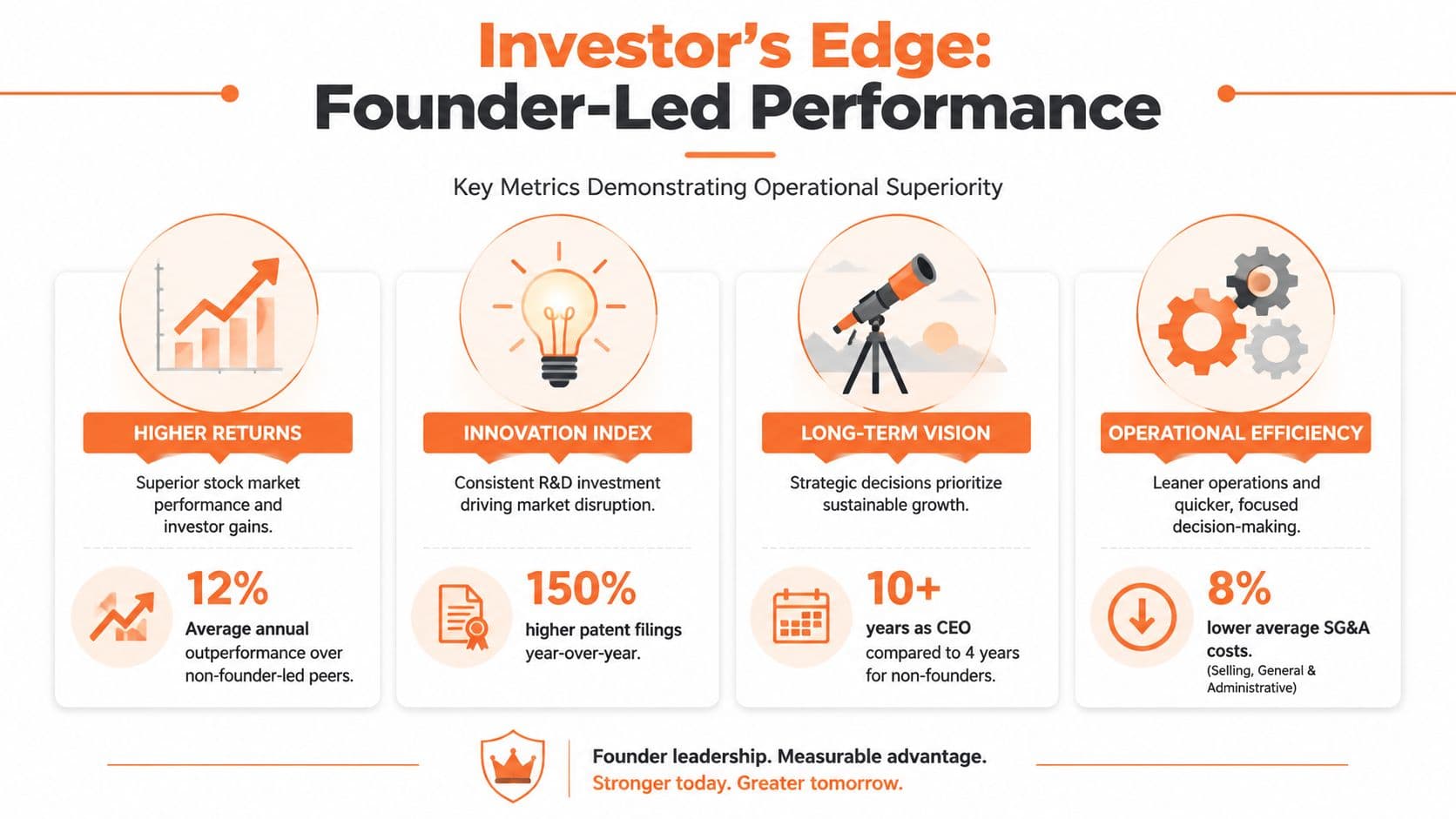
Empirical studies from Anchor Capital Advisors show founder-led businesses outperform peers across risk-return measures such as Sharpe ratios, standard deviation, and compound annual growth rates, and they often achieve customer acquisition costs 30-40% lower than industry averages.
Why the economics can be better#
The mechanism is usually straightforward.
Founders carry tacit knowledge that hired executives often spend years trying to reconstruct. They know why the product exists, which customer pains matter, where the business can afford to wait, and which corners can't be cut. That usually leads to faster decisions and fewer expensive detours.
The second advantage is time horizon. Founders are often more willing to invest behind product quality, distribution, hiring, or infrastructure that won't make the next quarter look prettier. Manager-led companies can absolutely do this too, but they face more agency friction.
A useful comparison#
| Attribute | Founder-Led Company | Manager-Led Company |
|---|---|---|
| Strategic horizon | Often longer-term and conviction-driven | Often shaped by reporting cadence and board signaling |
| Customer insight loop | Usually tighter to product and users | Often filtered through layers |
| Cost posture | More likely to treat spend as personal risk | More likely to optimize within budget categories |
| Decision speed | Faster when trust is centralized | Slower when approvals are distributed |
| Execution risk | Can be high if too dependent on one person | Can be high if accountability diffuses |
This doesn't mean every founder is investable. It means the upside case is easier to justify when a founder has both intensity and discipline.
What sophisticated investors look for#
A good investor doesn't ask only whether the founder is exceptional. They ask whether the company is becoming less fragile as it grows.
That means looking for signs like these:
- Codified judgment: Can the team explain how key decisions get made?
- Repeatable sales motion: Does growth rely on the founder's presence, or can others carry the message?
- Bench strength: Are there executives who challenge the founder constructively?
For founders raising capital, it helps to study how other teams connect with US venture capitalists and position the company around strategic fit instead of generic storytelling. The strongest founder narratives are backed by operating proof, not just ambition.
Investors pay a premium for founder judgment. They discount heavily when that judgment hasn't been turned into an organization.
The Common Pitfalls That Derail Growth#
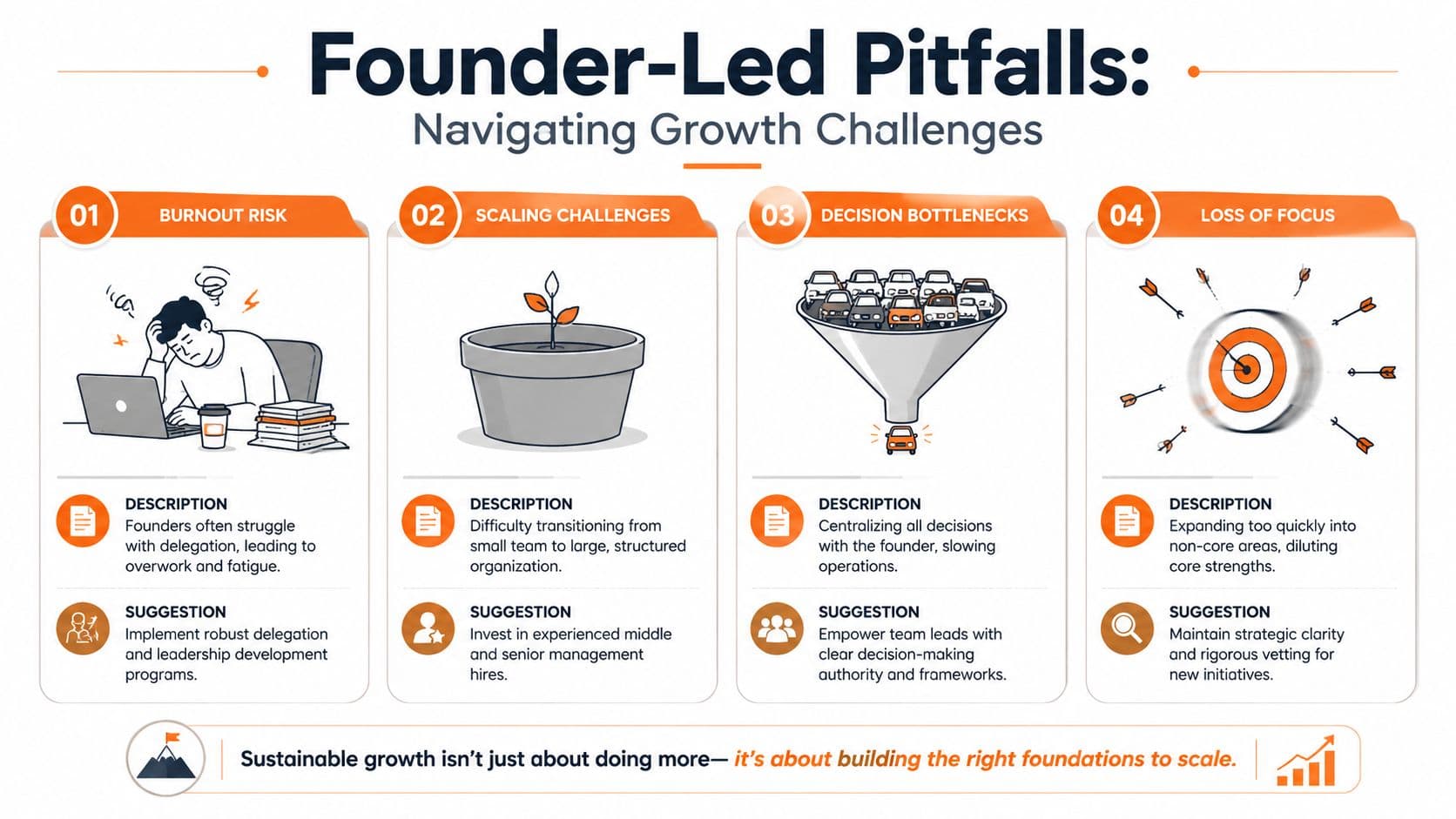
The same habits that create breakout momentum can become the reason growth stalls. This is the founder's dilemma in operational form.
The biggest mistake boards make is romanticizing founder intensity after the company needs structure. The biggest mistake founders make is assuming structure is the enemy of speed. It isn't. Bad structure is the enemy. Good structure protects speed by reducing confusion, duplicate decisions, and dependence on one person.
The culture handoff usually breaks first#
The sharpest warning sign is cultural drift hidden under strong top-line momentum. According to the 2024 McKinsey Global CEO Survey, 68% of founder-led companies fail to institutionalize their culture when scaling past 500 employees, which leads to a handoff failure where the owner's mindset becomes toxic rather than useful.
That failure rarely looks dramatic at first. It shows up as shadow approvals, leadership teams waiting for founder cues, and middle managers who optimize for reading the founder's mood instead of solving the problem in front of them.
Teams facing that transition usually need stronger operating documentation, not more Slack messages. A practical starting point is building a more durable system for company knowledge, like the approach discussed in this guide to a knowledge base builder for growing teams.
Four predictable traps#
- The founder bottleneck: Every meaningful decision routes upward. Teams slow down because authority exists, but it isn't distributed.
- Cultural cloning: The founder hires people who think the same way instead of people who fill execution gaps.
- Heroic improvisation: Early wins came from hustle, so the company keeps treating repeatable work like an emergency.
- Key-person fragility: Critical context lives in the founder's head, inbox, or meeting cadence.
These aren't personality flaws. They're design flaws.
What doesn't work#
Founders often respond to scaling pressure in one of two bad ways.
The first is total control. More reviews, more approvals, more “final eyes.” That creates precision at the cost of throughput.
The second is vague delegation. The founder says, “Own it,” but never defines the decision boundary, success criteria, or escalation path. People then either freeze or overreach.
The fix is narrower and more demanding. The founder has to decide which judgments remain personal and which become institutional. If that line never gets drawn, the company grows in headcount and revenue while shrinking in clarity.
Prominent Examples From The Real World#
The easiest way to understand founder led companies is to watch what founders do when the obvious answer looks wrong.
NVIDIA is a useful example. A founder-led company can keep placing long-horizon bets that look excessive until the market catches up. The outside lesson isn't “founders are visionaries.” It's that founder control can preserve strategic continuity long enough for a difficult thesis to mature.
Amazon illustrates a different point. Founder involvement often produces an unusual tolerance for operational friction in the short term if it serves a larger system advantage later. That can feel irrational to teams trained to optimize local metrics. In the best cases, it creates compounding infrastructure that hired operators might have underfunded.
Where founder leadership goes bad#
WeWork remains the cautionary version of the same story. The issue extended beyond aggressive growth. Plenty of ambitious companies grow aggressively.
The deeper problem was unchecked narrative power without enough operational constraint. Founder conviction outpaced governance, and the company treated charisma as a substitute for discipline. That's the version investors and boards need to spot early.
A healthy founder-led business can explain:
- Why this strategy wins
- What assumptions must hold
- Who can challenge the founder
- What evidence would force a change
An unhealthy one depends on personality to close those gaps.
The operator lesson#
Operators shouldn't copy famous founders. They should study the structure around them.
At strong founder-led companies, you usually find a sharp lieutenant structure, clear decision domains, and teams that can translate principles into execution. At weak ones, everybody waits for the room-reading exercise to finish.
For teams trying to understand what effective AI-era execution can look like in practice, these LLMBuddy client impact examples are useful because they show how organizations turn abstract tooling conversations into operational outcomes. The point isn't to imitate a case study. It's to look for evidence that systems, not personalities, are carrying the work.
Building A Scalable Founder Led Structure#
The founder's job changes twice. First, they build momentum. Later, they build a company that can carry momentum without them in every room.
That second job is where many founder led companies stumble.

Hire complements, not loyal replicas#
Early hires often succeed because they can keep up with the founder. Later hires need a different profile. They must absorb the founder's standard without becoming dependent on the founder's constant input.
That means resisting the temptation to hire only for chemistry. Chemistry matters, but complementarity matters more. A strong COO, chief of staff, head of product, or support leader often multiplies effectiveness by introducing discipline where the founder defaults to instinct.
Useful hiring questions are blunt:
- What kind of ambiguity can this person handle alone?
- Where will they disagree with the founder productively?
- Can they turn verbal context into repeatable operating behavior?
The wrong executive hire usually flatters the founder. The right one reduces founder load.
Use governance to widen judgment#
Founders often treat governance as drag. That's backward when the board is built well.
A good board doesn't dilute founder conviction. It pressure-tests assumptions, forces cleaner trade-offs, and creates moments where the founder has to separate preference from principle. Independent directors matter most when things are still going well, because that's when weak governance hides easiest.
For teams thinking through process automation alongside governance and operational scale, this piece on automated business solutions is a useful companion because it frames automation as a fundamental operational advantage rather than software theater.
Turn instinct into repeatable operating knowledge#
This is the hardest part because it feels slower than product work, fundraising, or hiring. It isn't optional.
Every founder carries a library of invisible judgment: how to respond to a customer escalation, what counts as a launch-ready feature, when to bend policy, when to refund, when to escalate legal review, what quality bar documentation must meet. If those rules stay unwritten, the company keeps paying the founder tax.
The right system doesn't produce bureaucracy. It produces transfer.
A practical structure looks like this:
- Document recurring decisions. Capture the situations that repeat, not just static policies.
- Assign decision owners. Teams need named authority, not shared ambiguity.
- Review exceptions. The founder should inspect edge cases, then decide whether the system needs an update.
- Audit clarity. If new managers interpret a process differently, the documentation is weak.
A strong document review platform for operational teams helps here because scale breaks first at the point where documents become stale, contested, or impossible to trust.
This is also where the practical gap between tools becomes obvious. Notion is flexible, but teams often end up with scattered pages, inconsistent structure, and weak publishing discipline. Confluence can become a graveyard fast if ownership isn't strict. Docusaurus and Mintlify can produce polished documentation, but they often impose setup and maintenance overhead that smaller ops or support teams don't want to carry. Founders need systems people will maintain.
One useful example from Dokly's official channel goes deeper on documentation workflow and platform thinking:
If the founder still has to explain the same operating judgment every week, the structure isn't finished. It's only deferred.
The New Frontier of Knowledge Sharing for AI#
AI is changing who reads your documentation first. In more companies, the first "user" of a help article, SOP, or product page is an agent retrieving and assembling answers, not a person clicking through a navigation tree.
That shift creates a new scaling test for founder-led companies. Founder knowledge has to be documented in a format that survives retrieval, summarization, and reuse by machines. If your operating logic lives in loosely structured pages, duplicated answers, or beautifully designed docs with weak underlying hierarchy, AI will return inconsistent output. At that point, the problem is no longer content quality alone. It is operating quality.
Tools matter here, but structure matters more. Notion is fast and flexible, which is why many teams start there. It also makes it easy to create sprawl, inconsistent naming, and pages that read well but parse poorly. Confluence can store a lot, but storage is not the same as usable knowledge. Docusaurus and Mintlify are stronger for published documentation, yet teams still get poor results when taxonomy, metadata, and ownership are loose.
Founders should treat machine readability as part of system design.
Ask a harder set of questions:
- Can an AI agent retrieve the right answer from the source without guessing?
- Do headings, metadata, and page relationships reflect how the company operates?
- Is there a clear source of truth, or are five slightly different versions competing for attention?
For teams tightening this layer, these knowledge management strategies for structured company information are a useful starting point.
One trade-off is easy to miss. Human-friendly documentation often tolerates ambiguity because a manager can fill in the gap live. AI cannot. It needs cleaner structure, sharper terminology, and explicit context. That discipline feels slower at first. It reduces support load, onboarding confusion, and answer drift later.
Undocumented judgment loses value. Poorly structured documentation traps value where neither a new hire nor an AI system can use it.
The founder-led companies that scale through this transition will do more than preserve culture. They will encode product truth, operating standards, and recurring decisions in systems that people and machines can both read reliably.
Conclusion The Enduring Founder Advantage#
The case for founder led companies is strong, but it's easy to oversimplify. Founders often create unusual performance because they bring urgency, alignment, and product truth into the room. That advantage is real.
It's also perishable.
The founder premium lasts only when instinct becomes system, when culture becomes teachable, and when decision quality survives delegation. The strongest founder-led businesses don't trap excellence in one person. They build structures that carry that excellence across teams, layers, and tools.
In 2026, that standard extends beyond people. A scalable company has to make its knowledge usable by machines too. That's no longer a side issue for technical teams. It's part of operating design.
The founders who endure won't be the ones who stay central to everything. They'll be the ones who architect companies that still act with clarity when they're not in the room.
If your team wants documentation that works as an operating system instead of a content dump, Dokly is worth a close look. It's a founder-led platform built for modern help centers, SOPs, onboarding docs, and product knowledge, with clean structure, fast publishing, and AI-readable output at the core. For teams tired of the setup tax in tools like Docusaurus or the sprawl that creeps into Notion and Confluence, Dokly makes the practical case easy. Your docs should be easy to maintain, easy to trust, and easy for AI to parse. Dokly is built for exactly that.