Most advice about the Pyramid Principle gets one thing wrong. It treats the method like a presentation trick.
It isn't. It's a discipline for forcing a messy thought into a form another person can understand quickly. That matters more now because your writing often gets read twice. First by a busy human. Then by a search system, assistant, or AI agent trying to decide whether your page is worth citing.
The usual fix for weak reports and confusing emails is “write more clearly.” That's incomplete. Clarity doesn't begin at the sentence level. It begins with the order of ideas. If the answer is buried, if the reasons overlap, or if the details arrive before the point, strong prose won't save you.
The pyramid principle logic in writing and thinking solves that problem by flipping the default order. You think through the mess first. Then you present the conclusion first.
Table of Contents#
- The Real Reason Your Reports and Emails Get Ignored
- What Is the Pyramid Principle
- Why Top-Down Communication Is So Effective
- How to Build Your Communication Pyramid
- Pyramid Principle Examples and Templates
- Updating the Pyramid Principle for AI and Modern Docs
- Common Mistakes and Workflow Integration
The Real Reason Your Reports and Emails Get Ignored#
Most ignored documents don't fail because the writer is careless. They fail because the writer dumps discovery in the order it happened.
That's the default in almost every workplace. Someone investigates a problem, gathers notes, pastes in screenshots, adds background, then finally reaches the recommendation in paragraph six. The writer feels thorough. The reader feels trapped.
What most people do wrong#
A bottom-up email usually sounds like this:
- Background first: a long recap of everything that happened
- Findings next: scattered observations, often with no grouping
- Recommendation last: the actual point, hidden at the end
That structure mirrors the writer's process, not the reader's need. Executives, PMs, support leads, and operations managers don't read to admire your journey. They read to answer one question: what should I know or do?
Practical rule: If your conclusion only appears after the reader has earned it, you've made the reader do your synthesis work.
What works instead#
A top-down note starts with the answer, then gives the reasons, then supplies proof only where needed.
Compare these two openings.
| Weak opening | Strong opening |
|---|---|
| “Over the past week we reviewed customer tickets, spoke to support, checked handoff steps, and found several issues in the current onboarding flow.” | “We should rewrite the onboarding flow because new users can't reliably find the first required action.” |
The second version creates direction instantly. The reader can agree, disagree, or ask for support. Either way, the conversation starts in the right place.
This is why the Pyramid Principle has lasted. It isn't polished rhetoric. It's reader respect expressed as structure. When you put the main answer first, you reduce the odds of confusion, misreading, and “can you summarize this for me?” replies.
What Is the Pyramid Principle#
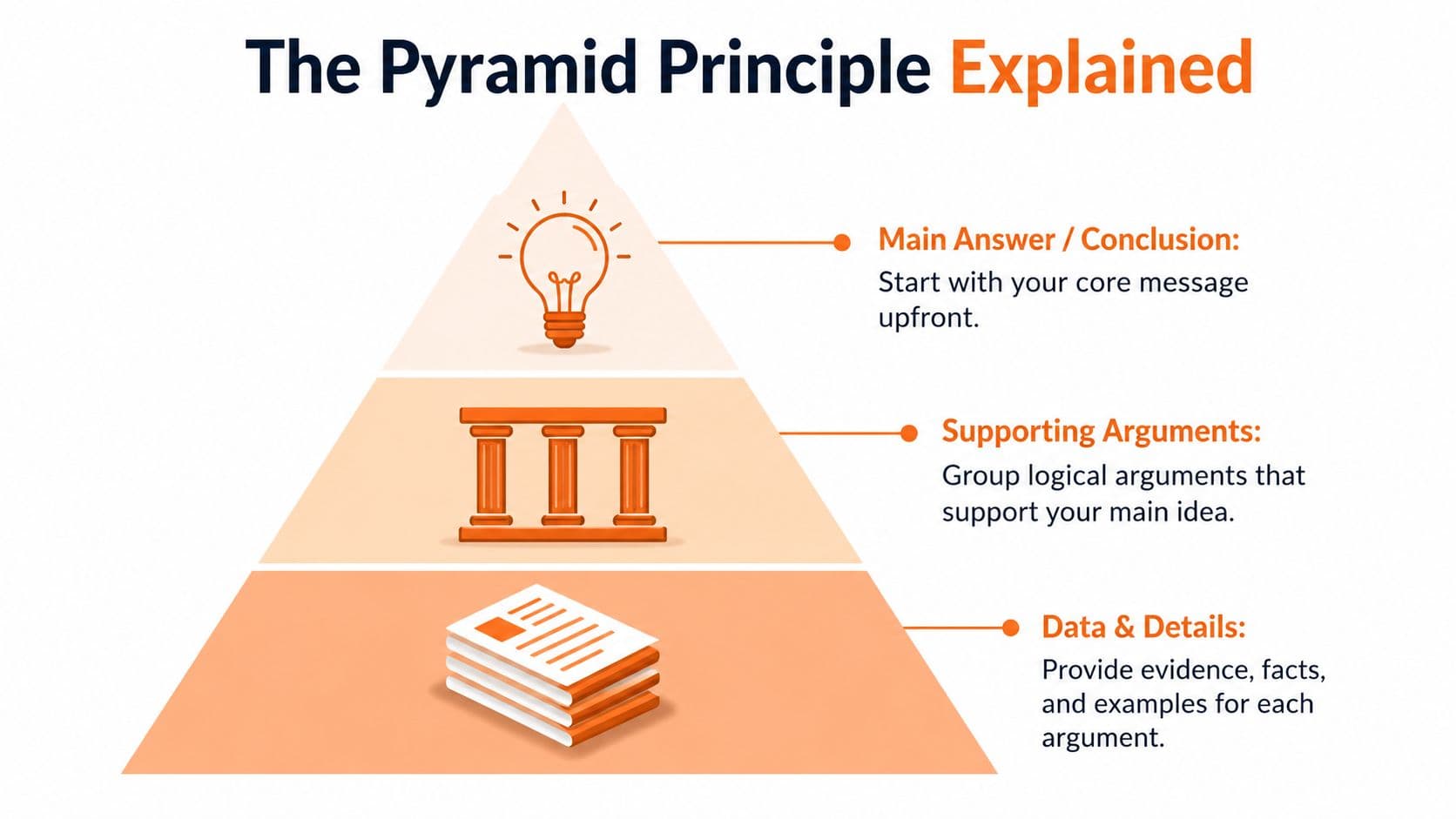
The Pyramid Principle is a method for organizing thought before you draft, then presenting that thought in a strict hierarchy. It was developed by former McKinsey consultant Barbara Minto in the 1970s. It mandates a hierarchical framework where the main idea occupies the apex, followed by 3 to 5 key supporting arguments, and granular details at the base. Ideas at any level must summarize those grouped below them, and groupings must follow the MECE principle, meaning Mutually Exclusive and Collectively Exhaustive, as described in this overview of Barbara Minto's framework.
The structure in one view#
Think of the pyramid as three levels.
- Apex: one governing thought. This is the answer, recommendation, decision, or conclusion.
- Middle layer: a small set of reasons that prove the answer holds.
- Base layer: facts, examples, evidence, and detail that support each reason.
If the middle layer doesn't clearly support the top, the argument is weak. If the base doesn't clearly support the middle, the detail is noise.
That's why a well-structured memo feels shorter even when it contains the same content. The hierarchy tells the reader what matters first.
The rules that make it work#
Two rules matter more than the rest.
First, every level must summarize the level below it. If you have three bullets under a heading, that heading should express what those bullets collectively mean. If it only labels a topic, it's not doing real work.
Second, the groups should be MECE. In practice, that means your reasons shouldn't overlap, and they shouldn't leave obvious holes. If one supporting point could sit under two headings, the structure is muddy. If a major reason is missing, the structure is incomplete.
The introduction often gets built with SCQA, which stands for Situation, Complication, Question, Answer. It gives the reader just enough setup to care about the answer.
A good style guide can reinforce this kind of discipline at the sentence and section level, making a practical resource like Dokly's technical writing style guide particularly useful for teams that already know what they want to say but still struggle to make pages scan well.
The Pyramid Principle doesn't ask you to sound smarter. It asks you to decide what the point is before you start typing.
Why Top-Down Communication Is So Effective#
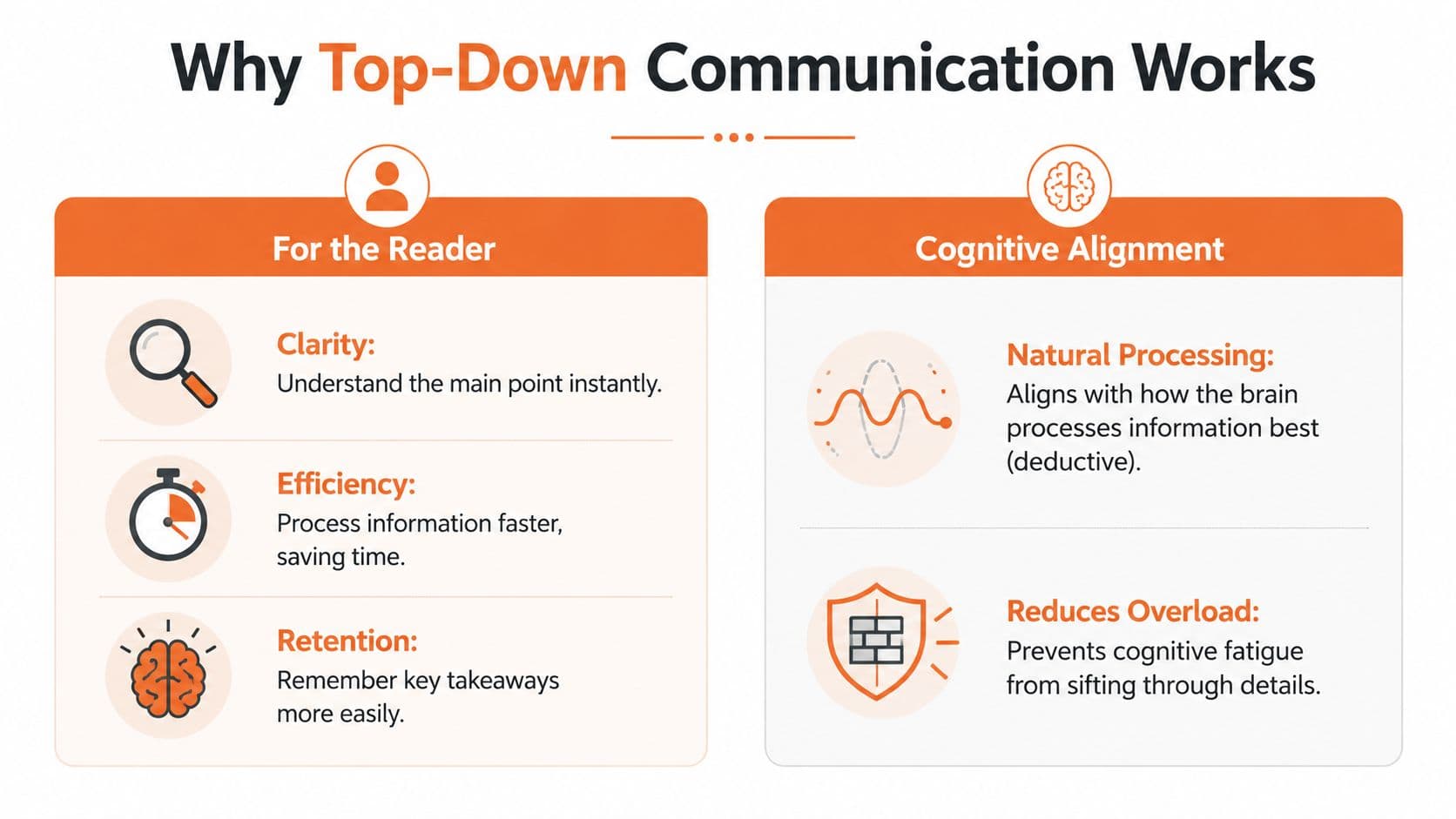
Top-down communication works because readers aren't trying to relive your analysis. They're trying to orient themselves fast.
When someone opens a status memo, an escalation note, or an internal proposal, they want a frame. Without that frame, every sentence creates more mental sorting work. The reader has to guess what matters, why it matters, and whether the details belong together.
Readers want orientation before detail#
Writers usually discover ideas from the bottom up. They review notes, compare patterns, test explanations, and only then settle on a recommendation.
Readers shouldn't have to go through that same sequence. They need the result of the synthesis first.
That's why top-down writing feels easier to absorb. The reader sees the conclusion, then the logic, then the evidence. Each layer answers the natural next question.
- What's the point
- Why should I believe it
- What supports each reason
This is especially important in high-friction documents like handoff notes, SOP updates, and product change summaries. If the top isn't stable, every lower section becomes harder to parse.
Why three ideas often work best#
Barbara Minto's framework establishes a useful constraint here. The “magic number” for supporting ideas is three, following the Rule of Three, a heuristic suggesting people process information most effectively in trios, as noted in this summary of the book's guidance.
That doesn't mean every memo must have three bullets by force. It means that if you're listing six equal-weight reasons, you probably haven't grouped them well enough yet.
A practical pattern looks like this:
| Weak support structure | Better support structure |
|---|---|
| Six disconnected bullets | Three grouped reasons |
| Mixed evidence and claims | Clear claims first, evidence underneath |
| Topics instead of judgments | Summary statements that advance the conclusion |
A reader can hold a few ideas in mind. They can't hold a pile.
The Pyramid Principle works because it removes decision fatigue from the reading experience. The writer does the hard grouping. The reader gets the shape of the argument immediately.
How to Build Your Communication Pyramid#
A common error in applying the Pyramid Principle is starting with the draft. That's backward. First build the logic. Then write.
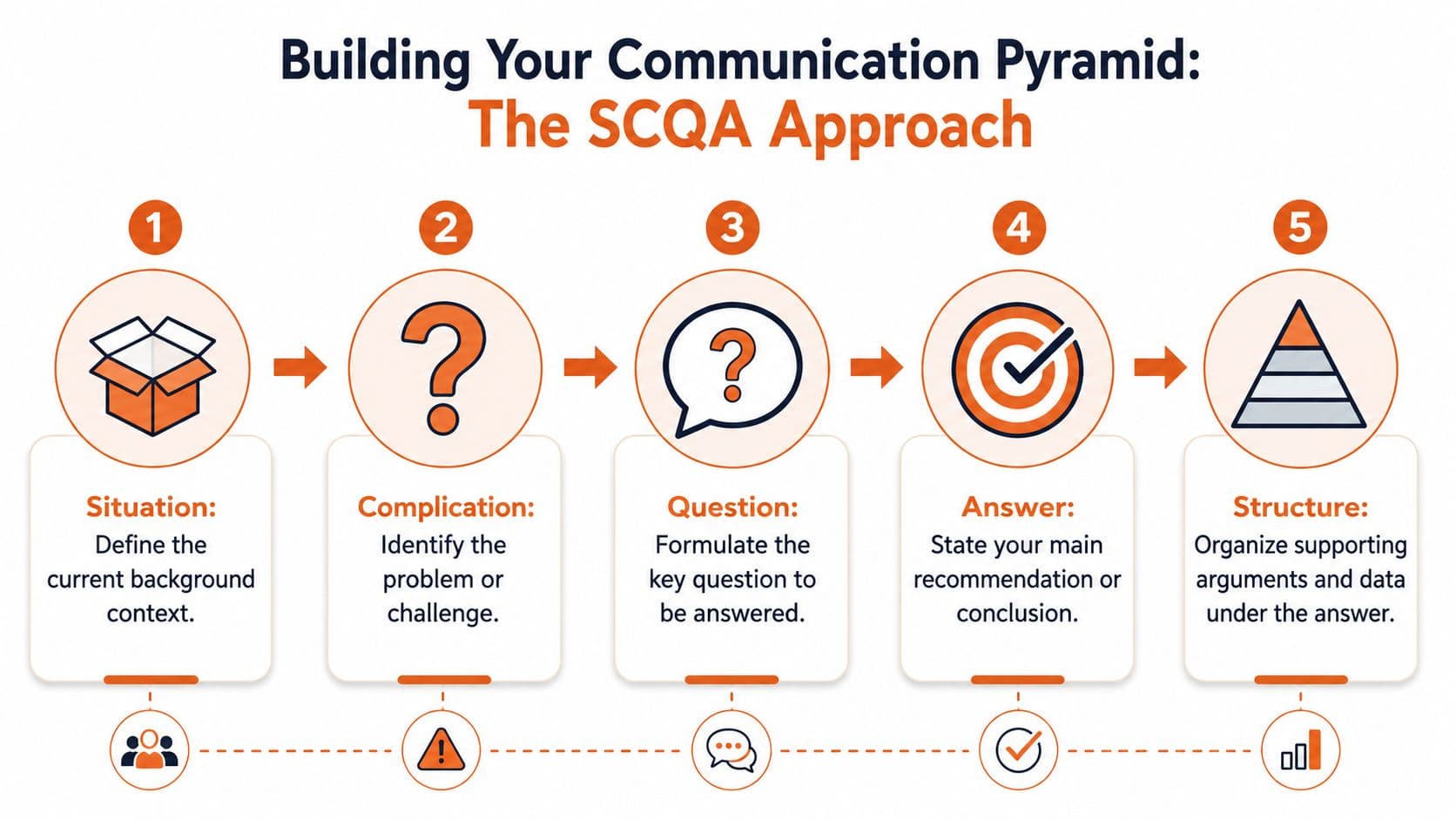
The practical engine for that logic is SCQA. Expert implementation relies on the SCQA framework, meaning Situation, Complication, Question, Answer, to establish the complication that necessitates the answer at the pyramid's top. The method also separates the thinking process from the writing process, requiring the complete pyramid structure to be drawn and conclusions verified before drafting begins, as explained in this discussion of SCQA and the drafting sequence.
Use SCQA to find the real answer#
Start with four short prompts.
-
Situation
State the current reality the reader already recognizes. Keep it neutral and familiar. -
Complication
Identify what changed, broke, or became risky. This is the tension. Without it, the document has no reason to exist. -
Question
Ask the obvious question the complication creates. The reader should feel this question before you write it. -
Answer
State the recommendation or conclusion cleanly. This becomes the top of your pyramid.
Here's a simple operational example.
- Situation: The support team uses a help center and internal SOPs to resolve onboarding tickets.
- Complication: Agents now give different answers because the SOP and help center say different things.
- Question: How should the team restore consistency?
- Answer: Consolidate the onboarding guidance into one maintained source and link all derivative content to it.
That answer can now sit at the top. Under it, you'd group reasons such as reduced contradiction, easier maintenance, and faster agent training. Under each reason, you'd place examples, ticket excerpts, or process details.
A solid supplementary resource for people structuring educational or creator content is Narrareach's blog post guide for creators. It's useful because the same logic problem appears outside consulting. Writers often know their material but haven't shaped the sequence.
Here's a visual walkthrough from Dokly's YouTube channel that complements the method in practice:
Draft in reverse from how you think#
After SCQA, sketch the pyramid before writing full sentences.
Use this quick build order:
- Write the answer first: one sentence, not a topic label
- List the reasons underneath: usually a compact set, with each reason distinct
- Attach proof under each reason: examples, metrics, screenshots, process notes, or source detail
- Check the vertical logic: each parent statement should summarize its children
- Only then draft paragraphs: the prose comes last
Diagnostic question: If your top line disappeared, would a reader still know your recommendation from the section headings alone? If not, the structure isn't strong enough yet.
Many teams often waste time. They draft too early, then “edit for clarity” when the actual issue is that no one decided the hierarchy.
Pyramid Principle Examples and Templates#
Theory gets overpraised. Rewrites teach faster.
The quickest way to learn the pyramid principle logic in writing and thinking is to watch a weak document become usable. Most workplace writing doesn't need elegant language. It needs a visible conclusion, clean support, and detail that stays in its lane.
Example one project status update#
Here's a familiar status email before structure:
We met with engineering and design this week about the rollout. There are a few blockers related to QA and some questions about copy approval. We also noticed some users still hit the old onboarding screen in certain cases. Support has flagged confusion in tickets. We may need to revisit the launch date depending on the remaining work.
Nothing is false. Everything is unusable.
A pyramid rewrite looks like this:
Recommendation: Move the rollout until the onboarding path is consistent.
Why:
- Users still reach the old screen in some scenarios.
- QA hasn't cleared the updated flow.
- Support is already seeing confusion tied to the mixed experience.
Detail: Engineering is investigating routing behavior, QA has unresolved checks, and support tickets show conflicting guidance reaching users.
The rewritten version does three things right.
- It states a decision: not a topic
- It groups the reasons: no overlap between routing, QA readiness, and user confusion
- It pushes detail downward: evidence supports the claim instead of replacing it
For teams documenting recurring updates, a reusable documentation skeleton helps. A practical starting point is this template for technical documentation, especially when you need consistent sections across product, support, and operations.
Example two release note#
A weak release note often reads like a feature dump:
Added role settings, revised notifications, updated approval flow, improved file display, and changed search behavior.
That tells the reader what changed, not what matters.
A stronger version uses the pyramid shape:
Release summary: This update makes admin work easier by improving permissions, approvals, and findability.
What changed:
- Permissions: Admins can now manage role settings more directly.
- Approvals: The approval flow has fewer ambiguous handoffs.
- Search and files: People can locate records and review assets with less friction.
Need-to-know details: Notification behavior changed in the approval process, so internal training material should be updated.
The logic is simple. Lead with value. Group by user meaning. Put implementation detail below.
That same pattern works for scripts and spoken explanations. If you publish internal walkthroughs or training videos, a resource like VideoLearningAI's free video script templates can help teams turn a loose feature list into a structured narrative.
For more applied guidance on content structure, Dokly's official channel is worth browsing at Dokly on YouTube. The useful part isn't branding. It's seeing how structured explanations hold together across formats.
Updating the Pyramid Principle for AI and Modern Docs#
The classic Pyramid Principle was built for human readers in consulting environments. That's still useful. It's no longer sufficient.
Today, documents also need to survive machine reading. Search systems, AI assistants, and code-aware tools don't “understand” a page the way a consultant does. They parse structure, headings, semantic relationships, and chunkable sections. That changes how rigidly you should apply old rules.
Where classic MECE helps and where it breaks#
A key challenge is that the Pyramid Principle's rigid MECE rule can conflict with the semantic, non-linear nature of AI-interpretable documentation. AI agents require semantic clustering over strict hierarchical exclusion to effectively chunk and recommend content, which many traditional guides fail to address, as noted in this discussion of MECE and AI-native documentation.

For human readers, strict exclusion is often excellent. It keeps a memo tight.
For AI-facing docs, over-enforcing exclusivity can create brittle content. A help article about onboarding might also belong to permissions, setup, and troubleshooting. If the structure refuses those semantic links, systems can struggle to surface the page in the right context.
That doesn't mean abandon hierarchy. It means keep the summary logic and loosen the taxonomy where needed.
Good modern documentation is hierarchical in presentation, but semantically connected underneath.
Why documentation format now affects discoverability#
Many traditional doc stacks fall short. Tools like Docusaurus and Mintlify can produce polished sites, but teams often end up with a high setup burden or pages that look good in the browser while becoming harder for machines to chunk cleanly once the content model gets messy.
A modern documentation workflow should preserve a few things at once:
- Clear headings: each section should carry a real idea, not a vague label
- Clean content blocks: prose, code, lists, and metadata should stay distinguishable
- Stable semantic relationships: related pages should be linkable without collapsing into duplication
- Low-friction editing: the tool shouldn't force people to choose between ease of use and structural quality
If you're exploring how AI can help shape documentation and writing workflows more broadly, Stimulead's guide on boost creative writing with AI is a useful contrast. It focuses on generation, while documentation teams also need structure, retrievability, and durable meaning.
The practical extension of this idea for documentation teams is straightforward. Write for a human skim. Structure for machine parsing. For a deeper look at that shift, this piece on docs for AI agents is worth reading.
Common Mistakes and Workflow Integration#
Teams rarely fail with the Pyramid Principle because the method is hard. They fail because they skip the thinking the method forces. I see the same problem in status updates, strategy memos, SOPs, and product docs. The page has structure, but the logic is still loose.
Three failure patterns#
- The “answer” is a topic, not a conclusion: “Onboarding process update” labels the subject. It does not tell the reader what changed, what matters, or what to do next. Replace it with a judgment, decision, or recommendation.
- The support points overlap: if two reasons partially repeat each other, the writer has not separated the ideas cleanly. Readers feel that repetition immediately, and AI systems often chunk and retrieve those points poorly for the same reason.
- The detail doesn't ladder up: evidence appears on the page, but the connection to the parent claim is missing. The reader has to infer the logic. That is where attention drops.
A quick self-check catches this early.
| Check | If yes | Fix |
|---|---|---|
| Is the top line just a subject? | The reader still does not know your point | Rewrite it as a conclusion |
| Do two middle bullets blur together? | The logic feels repetitive | Regroup until each reason is distinct |
| Do examples sit alone without a claim? | Detail is floating | Add the summary statement above them |
How teams can use this every day#
Use the method where confusion is expensive and time is short.
- Meeting agendas: lead with the decision required, then list the questions that must be resolved to make it
- Stand-ups: start with the takeaway, then blockers, then asks
- SOPs: open with the job to be done, then the phases, then the exact steps
- Onboarding docs: answer the new hire's first question at the top, then branch into supporting guidance
This matters more now because documents are read twice. First by people skimming for relevance. Then by AI tools trying to retrieve, summarize, and act on the content. Traditional documentation stacks can publish a neat hierarchy while still hiding weak logic underneath. AI-native systems such as Dokly handle this better because they make structure part of the writing workflow, not just part of the final presentation.
That is the practical standard. Every section should state a clear claim. Every lower level should support the level above it. If a human reader cannot follow the ladder, an AI agent will not recover it for you.