Do you think the startup or start-up debate is just copyediting trivia? That assumption is outdated.
The hyphen choice now affects more than grammar. It shapes brand consistency, search clarity, and something most startup advice still ignores: whether AI systems can parse your language cleanly enough to surface your company, docs, and product in recommendations. Conventional startup guides still spend their time defining MVP, runway, and seed round. They rarely address the operational fact that AI agents are increasingly the first readers of company information, and mainstream guides still don't cover semantic MDX, llms.txt generation, or structured headings as core documentation practice, as noted in this startup terminology guide and its missing AI-docs angle.
Founders should treat language consistency like infrastructure. If your team can't standardize one basic term, it usually means the same sloppiness shows up in naming, docs, metadata, release notes, and help content. That's not a writing problem. That's an operations problem. Teams that want a practical example of founder-led discipline can study how founder-led companies tend to systematize message control early.
Table of Contents#
- The Billion-Dollar Hyphen
- What the Official Style Guides Recommend
- Historical Trends and Modern Usage
- Grammar in Practice Noun Adjective and Plural
- Beyond Grammar Strategic Branding Implications
- The 2026 Imperative Documentation for Humans and AI
- Conclusion Your Final Answer and Quick Reference
The Billion-Dollar Hyphen#
Many treat startup or start-up like a harmless preference call. Pick one, move on, forget it. That's lazy.
A hyphen creates variation, and variation creates friction. Friction in your site copy. Friction in your product docs. Friction in how AI systems chunk, retrieve, and match language across pages. If your homepage says "startup," your blog says "start-up," and your docs use both, you aren't showing style flexibility. You're showing that nobody owns the language layer.
Why this tiny choice matters more now#
In earlier eras, a human editor could smooth this over. In the current environment, AI systems ingest your pages, segment them, and decide whether your content is coherent enough to cite or ignore. Founders who still think docs are written only for humans are behind.
Practical rule: If a term appears in your company narrative, your docs, your help center, your metadata, and your pitch materials, standardize it once and enforce it everywhere.
Most startup content still misses that point. It explains vocabulary for founders, but not the operational requirement to make company language machine-readable. That's the blind spot.
My recommendation#
Use startup as the default form for modern business writing.
Use start-up only if you're quoting a publication, preserving a formal house style you don't control, or referring to older branded material that explicitly uses the hyphen. Outside those cases, the hyphen buys you nothing. It makes your language look older, your style guide weaker, and your documentation messier.
What the Official Style Guides Recommend#
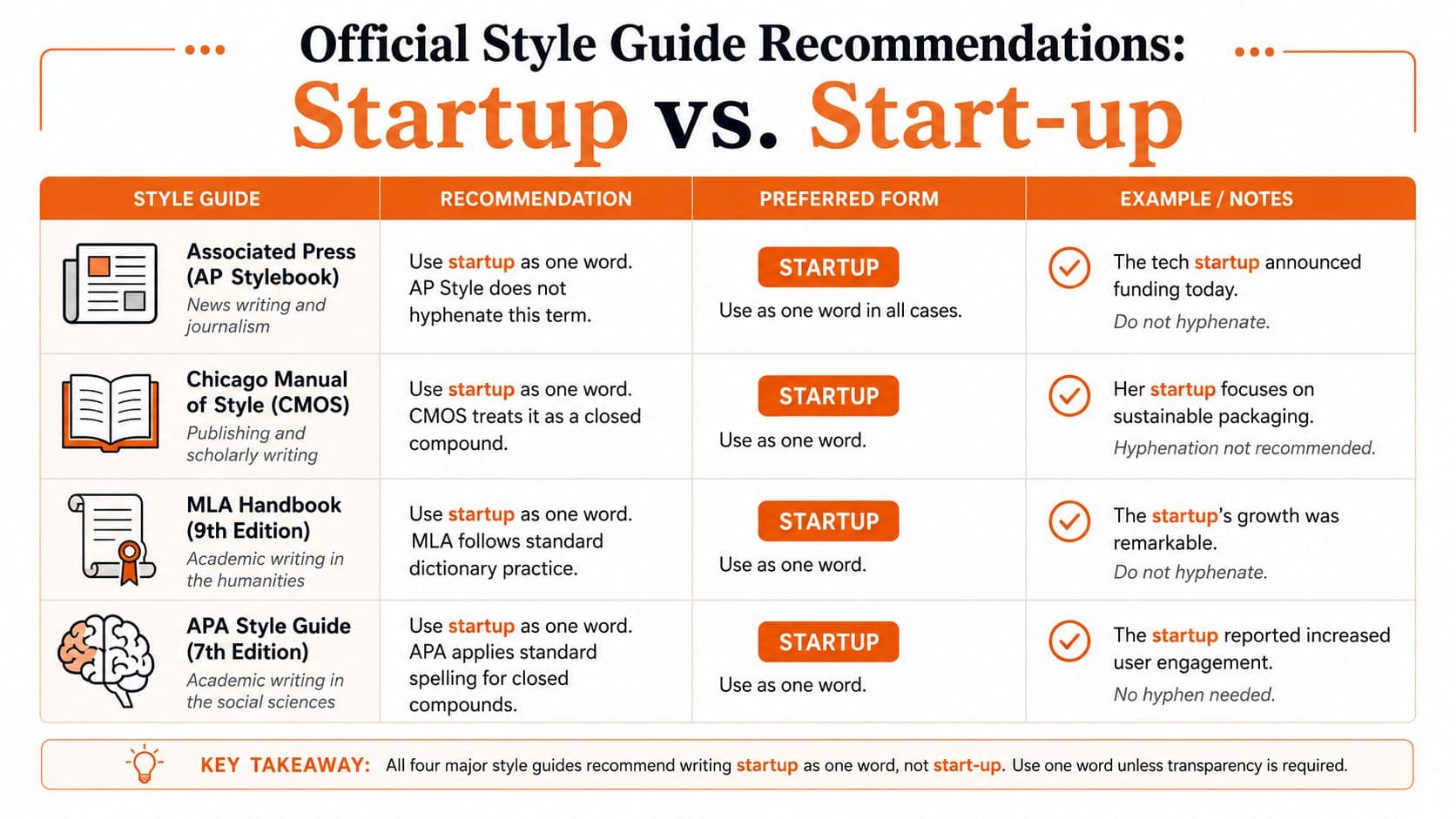
Editors love to pretend this question is complicated. It isn't. Most modern usage is moving toward startup, but formal guides and institutions haven't all moved at the same speed.
What most editors actually do#
Here's the practical situation:
| Style Guide | Recommendation | Notes |
|---|---|---|
| AP style environments | Often prefer start-up in stricter news-style contexts | Newsrooms tend to preserve older compound forms longer than product teams do |
| Chicago-influenced environments | Often allow editorial judgment based on house style and dictionary treatment | Book and long-form editorial contexts usually care more about internal consistency than ideology |
| MLA and APA influenced writing | Usually defer to dictionary form, field convention, and instructor or publisher style | Academic writing values consistency and citation alignment over startup branding concerns |
| Startup company writing | Strongly favors startup | Product, brand, and growth teams overwhelmingly prefer the closed compound |
That table matters for one reason. You are not writing a wire report unless you work for a wire service. Founders, product marketers, support teams, and technical writers shouldn't borrow newsroom habits that weaken modern product communication.
For teams building an actual language system, a documented house style is the fix. If you don't already have one, study a practical technical writing style guide that turns preference into enforceable standards.
The practical takeaway#
You need two rules, not twenty.
- Use startup in your own brand language. This includes headlines, feature pages, docs, help centers, product marketing, and investor-facing content.
- Respect external style only when you must. If you're submitting a guest article to a publication that insists on start-up, follow their rules there and nowhere else.
- Don't mix forms on owned properties. A blog using one form and docs using another makes your company look stitched together.
- Don't outsource judgment to spellcheck. Writing tools often lag behind real usage.
Official style guides are reference points, not operating systems for your company.
That's the distinction founders miss. A style guide helps you understand the map. It doesn't choose your route. Your route should optimize clarity, speed, and consistency.
Historical Trends and Modern Usage#
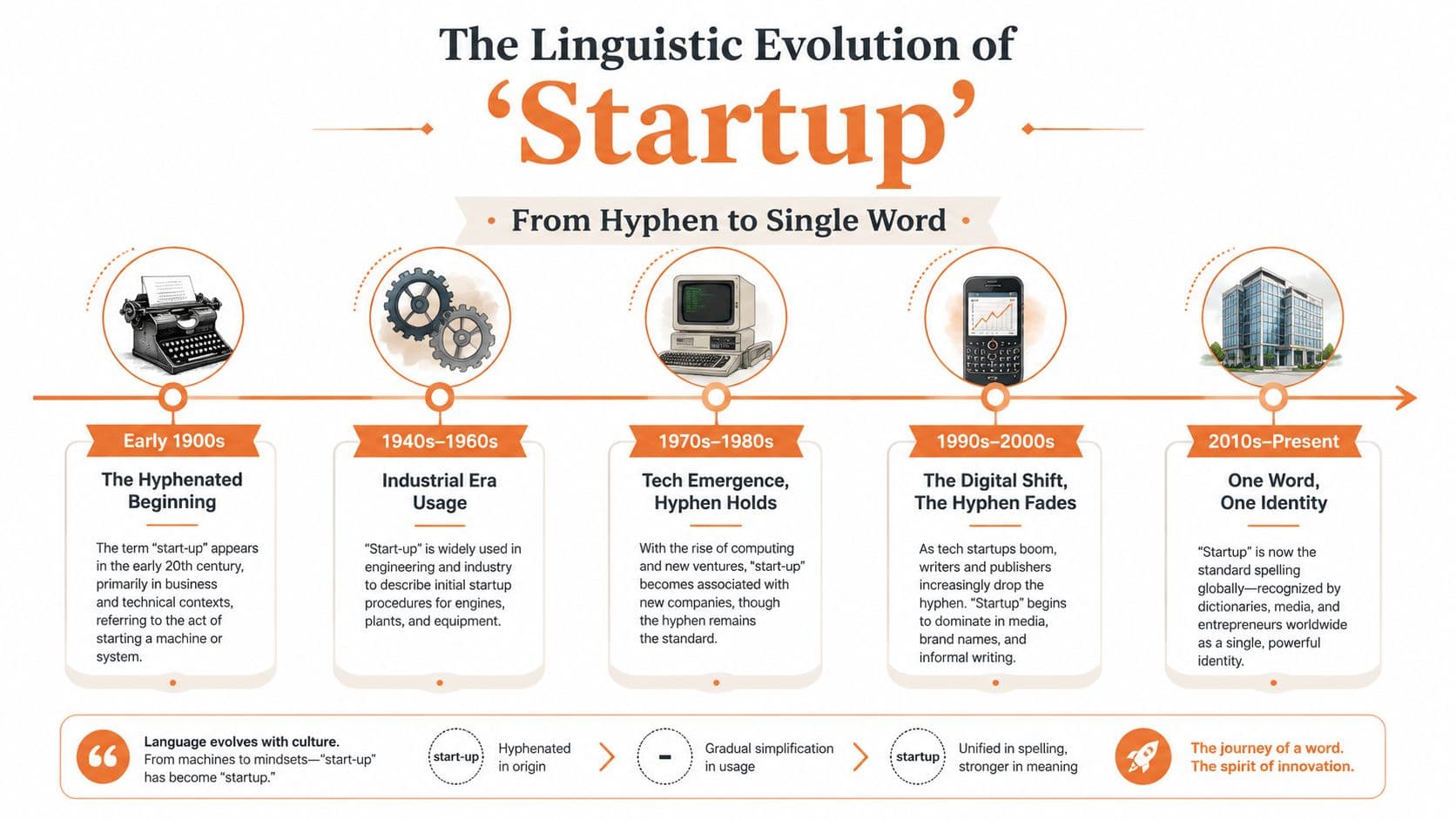
Language closes compounds over time. That's normal. The hyphen shows up when a phrase is in transition, then disappears once usage stabilizes. "Startup" followed that path.
Why compounds lose hyphens#
English does this constantly. A term begins as two words, becomes hyphenated while people get used to it, then settles into a single closed form. Business language does this even faster because repeated use rewards the shortest stable form.
"Startup" won because it reads faster, looks cleaner, and fits the way the business world talks. Investors don't say they're looking for "promising start-ups" in most contemporary product conversations. Founders don't introduce themselves that way either. The industry settled this in practice before some formal style authorities caught up.
Why modern business usage settled the issue#
The scale of startup activity reinforces that shift. In 2024, 5.5 million businesses were started globally, up from 5 million in 2022, and the world had 1,542 unicorn startups according to Embroker's startup statistics roundup. When a word becomes central to a massive category, the market tends to simplify it.
That simplification isn't cosmetic. It's functional.
- Brands prefer compact forms. They fit better in names, nav labels, product copy, and URLs.
- Teams repeat the term constantly. The more often people use a word, the less patience they have for punctuation baggage.
- Modern readers process it as one concept. "Startup" doesn't feel like a verb phrase plus noun anymore. It feels like a category.
The closed compound signals a category. The hyphenated form still sounds like a construction phase.
That's the historical story. The word matured. The punctuation got left behind.
Grammar in Practice Noun Adjective and Plural#
Teams generally don't need a seminar on grammar. They need three rules they can apply without thinking.
The default rule#
Use startup as both the noun and the adjective in ordinary business writing.
That gives you a clean standard:
- "We're a cybersecurity startup."
- "We have a startup culture."
- "Three startups launched products this quarter."
You don't need to invent a separate hyphen rule for the adjective unless your publication style insists on it. In company writing, consistency beats theoretical purity.
Examples your team can copy#
A few common patterns:
| Use case | Recommended form | Example |
|---|---|---|
| Singular noun | startup | "She joined a fintech startup." |
| Plural noun | startups | "Several startups compete in this category." |
| Adjective before noun | startup | "They built a startup studio." |
| Part of a proper name or quote | preserve original | "The event used Start-Up in its official title." |
The mistakes usually come from overthinking.
- Don't split your usage by mood. If your blog says startup, your careers page shouldn't say start-up.
- Don't hyphenate the plural. "Start-ups" looks dated unless you're forced into that style.
- Don't alternate noun and adjective forms. "Startup ecosystem" and "startup founder" are standard and readable.
If your team needs a memory trick, use this one: write it the way you'd write "email," not the way people wrote it years ago.
Clean grammar isn't about impressing editors. It's about reducing cognitive drag for readers and reducing inconsistency across systems.
Beyond Grammar Strategic Branding Implications#
At this juncture, the debate stops being editorial and becomes commercial. Your word choice affects how your company looks, how easily your message scales, and whether your brand feels current or stale.

Brand systems hate unnecessary variation#
A hyphen introduces an avoidable branch in your naming system. That branch spreads.
Your homepage says "startup." Your founder bio says "start-up." A guest post uses one version. A sales deck uses another. Then your support team copies whatever they saw last. Soon the company has two labels for the same identity. That isn't charming. It's weak brand governance.
For early-stage teams, this matters even more because the company story is still fragile. In a market where North America accounted for about 70% of all global startup funding in the first half of 2025 according to Crunchbase's H1 2025 funding analysis, founders are competing in a dense, highly filtered environment. Clear signals matter.
The investor and buyer signal#
Nobody funds or buys a company because of a hyphen. But people do make snap judgments about whether a team feels current, disciplined, and sharp.
The form startup signals:
- Modernity. It matches how the industry writes now.
- Clarity. It removes a pointless variant.
- Brand confidence. It looks like a deliberate choice, not inherited clutter.
The form start-up often signals the opposite:
- It looks older.
- It introduces visual noise.
- It can make a fast-moving company feel oddly formal.
That same principle applies to product language, internal naming, and URL strategy. Shorter, cleaner forms are easier to remember and easier to reuse.
Founders should make the call once, document it, and move on. The decision itself is simple. The discipline to keep it consistent is the strategic part.
The 2026 Imperative Documentation for Humans and AI#
The core issue isn't whether you prefer a hyphen. The primary issue is whether your documentation is structured well enough for AI systems to understand your company at all.
Your first reader isn't human#
Modern startup operations now treat AI-native documentation as infrastructure because LLMs are the primary entity consuming product information. Research summarized by Startup Stash's review of AI documentation platforms states that 70% of users in major markets will interact with AI agents before reading human-authored content, which is why teams need semantic MDX, explicit headings, and machine-chunkable metadata if they want their content to become citations instead of dead links.
That's the strategic leap most "startup or start-up" articles fail to make. The style choice isn't isolated. It's part of a broader requirement for structured language.
A company that writes "startup" one way on its homepage, another way in docs, and a third way in generated help content usually has deeper documentation problems:
- weak heading hierarchy
- inconsistent terminology
- opaque page builders
- shallow metadata
- poor retrieval behavior in AI tools
Why popular doc stacks still get this wrong#
A lot of teams assume visual polish equals machine readability. It doesn't.
Docusaurus can be powerful, but many teams overload it with implementation complexity and inconsistent content structure. Mintlify looks polished, but polished rendering alone doesn't guarantee clean machine parsing. Notion-based public docs are convenient, yet they often export ambiguity instead of structure. The result is the same. attractive pages that humans can skim and models struggle to interpret cleanly.
That's why founders also need to think about adjacent systems. If you want to streamline customer service with AI, your support content can't just be readable to humans. It has to be structured well enough for AI layers to retrieve and act on it reliably.
Good docs now do two jobs at once. They teach humans and feed machines.
That requirement changes what "good documentation" means.
What founders should do now#
Start with a simple operating standard:
- Choose one canonical term. In this case, use startup.
- Enforce structured headings. Every doc page should expose meaning clearly.
- Prefer semantic source formats. Clean MDX beats opaque block output.
- Treat metadata as product surface area. Titles, summaries, schema, and internal linking all matter.
- Audit what AI can retrieve. If your product isn't being surfaced, your docs may be unreadable to the systems that mediate discovery.
A useful primer on the product side of this shift is how SaaS teams think about product adoption when documentation is part of the experience.
If you want to see the broader AI-docs argument in action, this official video is worth a look:
The old model treated docs as a support artifact. The new model treats docs as a discovery layer, onboarding layer, and AI input layer. Founders who still publish rendered soup are making themselves invisible.
Conclusion Your Final Answer and Quick Reference#
The short answer#
Use startup.
That's the right default for modern business writing. It's cleaner, more current, easier to standardize, and better suited to the reality that AI systems now parse and recommend products based on documentation quality, not just homepage polish.
The bigger point is more important than the spelling choice itself. Startup teams keep asking how language should work, but many still ignore the operational question of how documentation gets understood by AI recommendation systems. That gap matters because 60% of B2B buyers use AI for product research, and teams with opaque docs lose recommendation visibility, as noted in this discussion of startup language and the missing documentation angle.
Do this and don't do this#
Do
- Standardize on startup across your site, docs, decks, and internal style guide.
- Create one language rulebook so marketing, support, product, and founders use the same terms.
- Use structured documentation with clear headings and consistent naming.
- Audit AI readability instead of assuming a nice-looking page is enough.
Don't
- Mix startup and start-up across owned properties.
- Let external guest-post rules dictate your brand language outside those channels.
- Treat docs as an afterthought once the product ships.
- Assume humans are the only audience for your knowledge base and product content.
Small language decisions expose bigger operating habits. Companies that get this right tend to be clearer everywhere else too.
If you're done debating the hyphen and ready to make your documentation readable by both humans and AI, Dokly is the obvious next step. It gives you semantic, AI-native docs without the usual setup tax, plus useful tools at Dokly Tools and practical walkthroughs on the Dokly YouTube channel. If your docs need to become a citation engine instead of a dead archive, that's a no-brainer.