Most employee handbooks fail for a simple reason. They're written like legal archives and used like operating manuals.
That mismatch is expensive in time, clarity, and risk. The U.S. Chamber of Commerce guidance on employee handbooks doesn't just focus on policy topics like nondiscrimination, anti-harassment, safety, attendance, and performance reviews. It also recommends a clickable table of contents and clear headings for digital versions so employees can find rules quickly and employers can present policies consistently across teams and locations (U.S. Chamber of Commerce handbook guidance).
That detail matters more than commonly acknowledged. If people can't find the policy, the policy may as well not exist. An employee handbook template is useful, but its true value comes from the system behind it: how you draft, structure, publish, update, and acknowledge it.
Table of Contents#
- Your Handbook Is a Product Not a Document
- The Core Components of a 2026 Handbook
- Why Your Current Tools Are Setting You Up to Fail
- A Practical Process for Drafting Your Handbook
- Legal Guardrails Versioning and Maintenance
- Publishing an AI-Native Handbook on Dokly
- Your Handbook Is Your Companys OS
Your Handbook Is a Product Not a Document#
Most handbooks are bad products.
They're dense, defensive, and written to satisfy review cycles instead of helping employees get answers. The usual pattern is familiar: HR and legal spend days polishing a file, export a PDF, upload it somewhere obscure, and then wonder why managers still answer the same questions in Slack every week.
A modern employee handbook template should be treated as a starting interface, not a finished artifact. Its real job is to reduce repeated questions, make expectations visible, and give the company one place to point when decisions need to be consistent. If it can't do that, it isn't working.
Practical rule: If a new hire can't find your PTO policy, remote meeting norms, and performance review expectations in a few clicks, your handbook isn't a handbook. It's storage.
This is why the best People teams think like product teams. They care about discoverability, naming, structure, revision workflows, and whether the content reflects how the company operates. They don't confuse “written down” with “usable.”
That shift also changes what a template is for. A good template gives you a skeleton. It doesn't know your communication culture, escalation paths, manager expectations, or local employment requirements. Teams still need to shape the material around actual behavior, then publish it somewhere employees will return to. If you're already thinking about the handbook as part of a broader internal knowledge base strategy, you're thinking about it correctly.
The blunt truth is that employees don't need another ceremonial document. They need a reliable operating reference.
The Core Components of a 2026 Handbook#
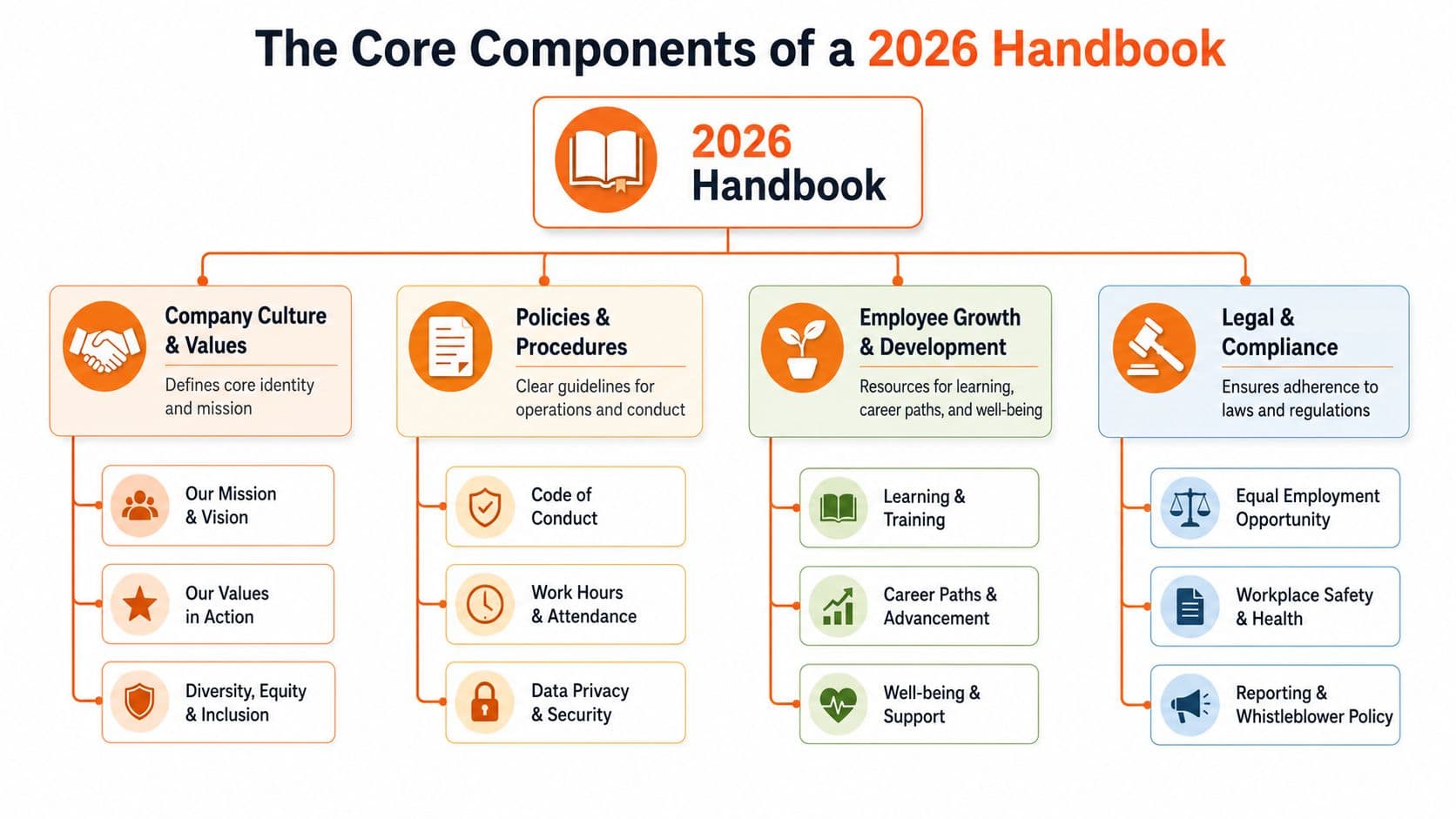
A 2026 handbook has to do more than list policies. It has to answer questions fast, hold up under legal review, and work as a searchable system that both employees and AI tools can interpret correctly.
Start with real decisions, not template headings#
The fastest way to build a weak handbook is to copy a generic table of contents and fill in the blanks. That usually produces a document full of formal policy language and very little operational value.
Employees are trying to answer practical questions. Managers are trying to apply rules consistently. HR is trying to reduce edge-case chaos without creating legal risk. Your handbook should be built around those jobs.
That means covering the legal baseline, but also writing down the operating rules people trip over every week:
- Communication norms: Which channels are for urgent issues, which are for routine updates, and what response times people should expect.
- Meeting expectations: When meetings should happen, who owns agendas, whether notes are required, and how remote participants are included.
- Performance and feedback: Review cadence, goal setting, manager responsibilities, and how concerns get raised before they become surprises.
- Work hours and availability: Core collaboration hours, flexibility rules, timekeeping if applicable, and team overlap expectations.
- Expenses and approvals: What employees can spend, who approves it, and how reimbursement works.
- Security and system use: Access handling, acceptable use, data protection basics, and what to do if something looks wrong.
If you want another perspective on building a culture-centered handbook structure, the LeaveWizard solution for HR is a useful reference point for framing handbook content around team norms rather than just legal language.
Organize by how work actually happens#
A good handbook structure follows the employee experience. Legal categories still matter, but they should not be the only organizing logic.
I usually recommend a structure closer to an operating manual than a compliance binder:
| Handbook area | What it should help an employee do |
|---|---|
| Company basics | Understand mission, values, decision-making norms, and who is accountable for what |
| Working here | Understand work hours, communication practices, office, remote, or hybrid expectations |
| People practices | Find guidance on feedback, reviews, growth, time off, benefits, and employee support |
| Conduct and safety | Understand behavior standards, reporting paths, anti-harassment rules, and safety requirements |
| Tools and security | Use company systems correctly and protect company and customer information |
| Employment terms | Review classification, attendance, leave, separation terms, and acknowledgments |
This structure reduces friction because it matches the way employees search. They do not wake up wondering which subsection contains "attendance and punctuality." They want to know whether they can work from home next Friday, who approves travel, or what to do after a security incident.
That difference matters even more now because AI assistants and enterprise search tools rely on clean structure, plain language, and clear page-level topics. If your handbook is written like a stitched-together legal memo, people will struggle to use it and AI will return weak answers.
Write for scanning, retrieval, and enforcement#
Ceremonial language is one of the biggest handbook failures I see. It sounds official, but it creates ambiguity, and ambiguity is where inconsistent manager behavior and legal problems start.
Each section should answer three questions clearly:
- What is the rule or expectation?
- Who does it apply to, and when?
- What should the employee or manager do next?
Short sections work better. Direct labels work better. Examples help when a policy is easy to misread. Cross-references help when one rule depends on another. Dense paragraphs copied from outside counsel usually do not help unless someone rewrites them into usable guidance.
A handbook should describe actual company practice with enough precision that a manager can apply it the same way every time.
That last point is where teams get into trouble. They publish aspirational language instead of operational truth. If feedback happens twice a year, say that. If flexible work depends on role coverage, say that. If approval authority sits with the department head, put that in writing.
A handbook earns trust when employees can rely on it. Once people learn that the written policy and real practice are different, the handbook stops being a source of truth and becomes a liability.
Why Your Current Tools Are Setting You Up to Fail#
The handbook problem usually isn't the template. It's the tool.
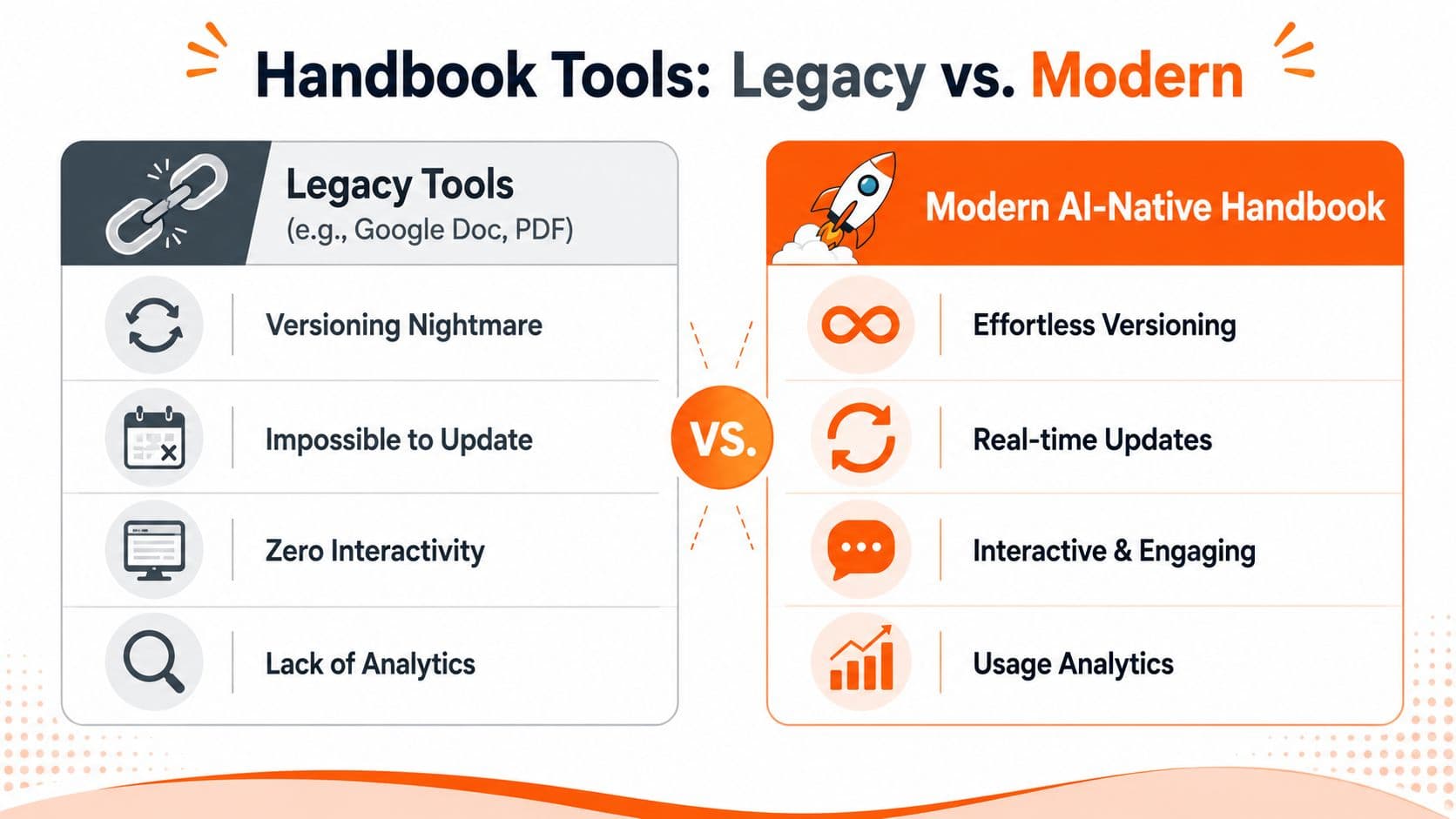
Teams blame content when the underlying issue is that they're publishing critical policy guidance in formats that are painful to update, awkward to search, and detached from any controlled review process. If your handbook lives as a PDF attachment or a dusty Google Doc, you've already chosen friction.
Static files break the moment work changes#
A PDF feels official. That's its main appeal.
It also creates a maintenance trap. Every update turns into a manual hunt across old files, filenames, attachments, bookmarks, and onboarding packets. Someone changes leave guidance or remote-work expectations, but the employee still has last quarter's version in a downloads folder. Then a manager links a different copy from an old HR drive. Now nobody is fully sure which policy applies.
Static files also encourage bad behavior from authors. People write giant sections because “it's all in one document anyway.” Search suffers. Linking suffers. Change visibility disappears.
Here's what static formats usually get wrong:
- Version clarity disappears: Employees can't easily tell whether they're reading the current policy.
- Updates become expensive: Small edits trigger awkward republication and redistribution work.
- Search quality is weak: People search by question, while PDFs tend to be organized by formal section titles.
- Policy trust erodes: Once employees encounter one outdated section, they start treating the whole handbook as unreliable.
General purpose wikis solve some problems and create others#
Notion, Confluence, and similar tools are better than static files. They're faster to edit and easier to browse. For many teams, they're a clear improvement over PDF-first publishing.
But they still come with trade-offs for handbook use. They're broad collaboration tools, not purpose-built controlled policy systems. Structure gets messy fast. Pages proliferate. Permissions get inconsistent. Employees land on an outdated child page or a draft someone forgot to archive. Content design becomes whatever the last editor felt like doing.
There's another practical issue. If your team is beginning to rely on AI tools to answer internal questions, generic block-heavy editors often don't produce the cleanest machine-readable output. A handbook that looks acceptable to a human browser can still be hard for AI systems to interpret cleanly.
When employees start asking AI for policy answers, unreadable documentation becomes invisible documentation.
What a handbook system actually needs#
A workable handbook platform should support a few essential features:
- Clean hierarchy: Policies need stable sections, predictable headings, and clear parent-child structure.
- Controlled publishing: Draft, review, publish, and archive should be distinct states.
- Search that respects intent: Employees search “Can I expense a monitor?” not “reimbursement policy subsection.”
- Visible ownership: Every policy should have an accountable owner and review rhythm.
- Machine readability: If AI assistants are part of your stack, your handbook should be legible to them too.
That's why I'm skeptical of “just use a doc” advice. It sounds cheap and fast. It usually turns into policy sprawl.
A Practical Process for Drafting Your Handbook#
A handbook shouldn't start with a blank page. It should start with evidence.
The best drafting process I've seen looks backward before it writes forward. Instead of guessing what belongs in the handbook, pull the questions, exceptions, and incidents your team has already dealt with. That approach is baked into modern HR guidance. AIHR highlights a discovery process that mines a full year of HR tickets, interviews managers in short sessions, surveys employees with five questions or fewer, and reviews incident patterns from the past two years so the handbook addresses recurring issues rather than just filling a template (AIHR employee handbook template guidance).

Use support history before you write a word#
Start by collecting the places where policy confusion already shows up.
That usually includes HR inboxes, People Ops tickets, onboarding questions, manager escalation threads, employee relations issues, and recurring Slack or Teams questions. You're looking for repeat patterns, not edge-case drama.
A simple review lens works well:
- Repeated employee questions: These belong in clear, searchable handbook sections.
- Manager inconsistency: These need decision rules, not vague principles.
- Frequent exceptions: These often point to a missing policy or a broken one.
- Incident patterns: These tell you where wording, training, or escalation paths are weak.
If your organization runs HR data and workflow inside Microsoft environments, a reference like Dynamics 365 HR policy integration can help teams think through how handbook content connects to operational systems rather than floating as a disconnected document.
Draft from reality not aspiration#
Founders and leadership teams often get sloppy. They write the handbook they want to have, not the company they run.
If approvals happen through managers today, write that. If remote norms vary by team but there's a baseline expectation for overlap hours, document the baseline and identify local variation. If you're still maturing performance management, say what exists now and what managers are expected to do consistently.
I use the same discipline here that operations teams use when they write standard operating procedures that reflect actual workflows. The standard shouldn't describe an imaginary process. It should describe the process your team can execute repeatedly.
A handbook earns trust when employees recognize their workplace in it.
Build sections in the order employees experience them#
Don't draft alphabetically. Draft by employee journey.
A practical order often looks like this:
-
Join and onboard
Employment basics, documents, equipment, systems access, introductions, training expectations. -
Do the work
Working hours, communication, meetings, remote or hybrid norms, expenses, security, conduct. -
Grow and get feedback
Performance reviews, manager check-ins, development support, internal mobility if relevant. -
Use support systems
Time off, benefits, leave processes, accommodations, reporting paths, employee assistance resources. -
Change or exit
Role changes, disciplinary processes where appropriate, resignation logistics, return of company property.
That sequence forces clarity. It also exposes gaps fast. If you can't explain how an employee moves through normal work life without hand-waving, your handbook still isn't ready.
Legal Guardrails Versioning and Maintenance#
An outdated handbook is a liability wrapped in false confidence.
A lot of teams assume that once legal approves the draft, the hard part is done. It isn't. The hard part is maintaining policy clarity after real life starts changing. New states. New leave rules. New remote practices. New reporting channels. New manager behaviors. A handbook that doesn't keep up stops protecting anyone.
Treat the handbook like a controlled document#
Thomson Reuters is clear on the process side. Handbook enforceability relies on periodic legal review, explicit employee notice of updates, and a signed acknowledgment of receipt so there's no ambiguity about which version applies (Thomson Reuters handbook best practices).
That means your maintenance model should include more than “upload revised file.”
Use a control structure like this:
| Control element | What good looks like |
|---|---|
| Version ID | Every published handbook and major policy has a visible version marker |
| Change log | Employees can see what changed, when, and why it matters |
| Notice workflow | Updates are actively communicated, not silently swapped in |
| Acknowledgment | New hires and existing employees confirm receipt when required |
| Review ownership | Each section has a business owner and legal review trigger |
If you want a legal-first perspective on why this level of rigor matters, the well-drafted employee policy guide is a helpful companion read.
Separate global rules from local addenda#
At this stage, scaling companies get into trouble.
Universal standards should live in one place. Anti-harassment expectations, workplace safety principles, reporting channels, security basics, and core conduct norms usually belong in your main handbook. Local requirements should sit in attached addenda by jurisdiction.
That structure matters for remote and multi-state teams because it avoids two bad outcomes:
- Overwriting universal policy with local detail
- Pretending one rule applies everywhere when it doesn't
A stable maintenance process also depends on disciplined documentation version control practices. If People, Legal, and Operations can't tell which local addendum matches which core handbook version, review breaks down fast.
What breaks enforceability fast#
In practice, the most common failures are mundane:
- Static PDFs with unclear update paths
- Revised policies published without explicit notice
- Missing acknowledgment records
- Conflicting rules across handbooks, offer letters, and manager playbooks
- Policies copied from templates that don't match actual company practice
None of this is glamorous. It's operational hygiene.
But when an employee dispute, manager inconsistency, or compliance review surfaces, this is the difference between “we have a handbook” and “we can show what policy applied, when it changed, and how employees were informed.”
Publishing an AI-Native Handbook on Dokly#
People teams often don't need another documentation project. They need a publishing workflow that doesn't require engineering help, repo knowledge, or endless cleanup after copying from a doc editor.
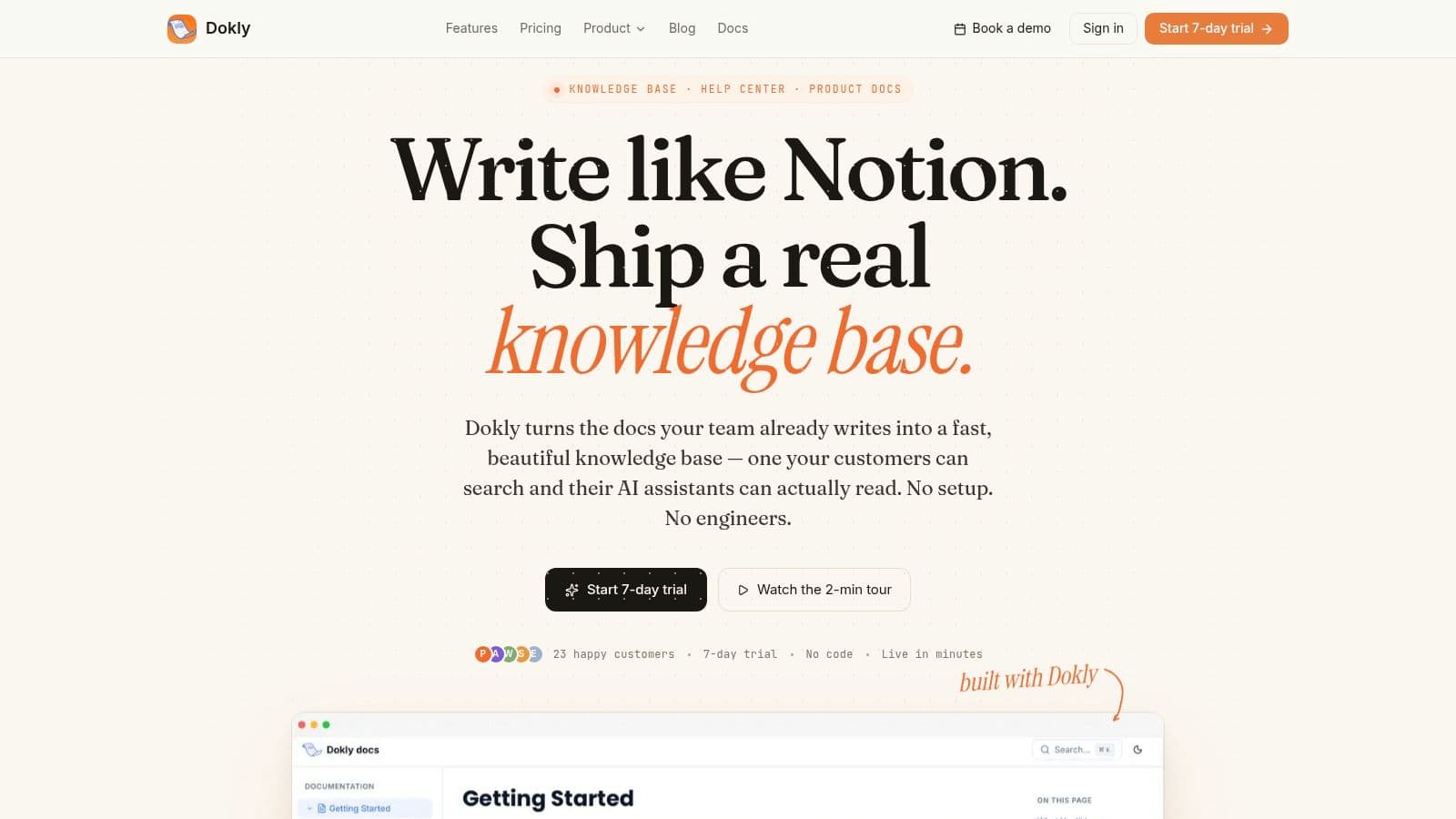
That's where Dokly is unusually practical for handbook publishing. It removes a lot of the technical drag that pushes HR teams back toward PDFs and generic wiki pages.
Move from draft to live handbook without technical drag#
The useful part starts with the editor. You can draft and structure content in a familiar visual interface, organize sections with drag-and-drop, and publish without setting up a documentation stack from scratch.
That matters more than it sounds. Handbook work dies when it becomes a side quest for IT or a dependency on a developer who has more urgent priorities. People teams need to own the content and the publishing flow directly.
A practical Dokly workflow looks like this:
- Import or paste your draft: Start from your working content instead of rebuilding the handbook in a code-based doc tool.
- Break content into navigable sections: Separate onboarding, conduct, benefits, leave, performance, and local addenda into clear pages.
- Publish to a clean site: Give employees one stable place to find the current handbook.
- Update continuously: Revise live content as policies evolve instead of recreating full-document exports.
You can also explore Dokly's official walkthroughs and product demos on the Dokly YouTube channel, which is useful if you want to see the publishing flow before rebuilding your own handbook environment.
Why AI readability now matters#
The handbook's audience is no longer just human.
Employees increasingly ask AI assistants for internal answers in the same way they search the web. If your published handbook is hard for AI systems to parse, it becomes less likely to surface as the authoritative answer. Dokly's core advantage is that it was built around machine-readable documentation, including clean semantic output and automatically generated AI-facing files such as llms.txt.
That's not a gimmick. It changes whether your policy library is usable in the workflows employees are already moving toward.
The first reader of internal documentation is often no longer a person opening a menu. It's an agent trying to answer a question.
A better publishing workflow for People teams#
Compared with Docusaurus-style setups, Dokly is simpler to own. Compared with Notion, it gives you a more purpose-built publishing surface. Compared with PDF-first handbooks, it's plainly more maintainable.
For HR and People Ops, the practical upside is straightforward:
- Cleaner navigation for employees
- Faster updates when policies change
- Better structure for controlled handbook sections
- A format that works for both browsing and AI retrieval
If you're going to put real effort into building an employee handbook template your team will use, it makes sense to publish it in a system built for access, structure, and change.
Your Handbook Is Your Companys OS#
A handbook isn't paperwork. It's infrastructure.
It sets defaults for how employees work, how managers make calls, and how the company handles situations that would otherwise become one-off exceptions. When it's well built, it reduces repeated questions, lowers avoidable friction, and gives people confidence that rules are applied consistently.
When it's poorly built, the opposite happens. Managers improvise. Employees rely on hearsay. HR becomes a routing layer for questions the handbook should've answered on its own.
That's why the system matters more than the template. Content still matters, obviously. But the handbook people use is the one that's searchable, current, versioned, readable, and grounded in reality. It has to work for humans first, and increasingly for AI systems too.
Build that, and your handbook stops being an annual compliance chore. It becomes part of how the company runs.
If you want a simpler way to publish a living employee handbook instead of another dead PDF, Dokly is worth a hard look. It gives People teams a clean editor, structured documentation, fast publishing, and AI-readable output without the setup tax of developer-first doc tools. For teams building handbooks, SOPs, and internal knowledge bases that need to stay current, it's the kind of platform that quickly becomes the obvious choice.